
Finding People Through Utah County Records
Utah County has no single government people finder. The best starting point depends on what is known. A full name can lead to land ownership, recorded documents, a court party entry, or a state license. An address can point to a parcel owner and then to earlier deeds. For someone who lived in Provo long ago, a city directory or obituary citation may work better than any current database.
Keep identities separate until two or more details agree. A common name in a deed index may belong to a company, trustee, or another resident. Dates, middle initials, parcel serials, case roles, and known relatives help sort the matches. Then follow the record back to the agency that created it.
- Search the county land hub by owner or address, then note the parcel serial and vesting document.
- Try the Recorder party index for deeds, liens, and other instruments tied to the name.
- Check district and justice court names, narrowing by court, date, or case type.
- For a past resident, move to marriage, probate, obituary, cemetery, and directory sources.
- Ask the correct custodian for a named record when no public index answers the question.
Note: A land, court, or directory name match identifies a record candidate; it does not prove that two entries describe the same person.
Utah County Records Office Routes
Several Provo offices hold different parts of the Utah County record trail. The Recorder keeps deeds, liens, plats, mortgages, and land indexes. The Clerk keeps Utah County marriage licenses, elections material, and the county records-management route. Recent birth and death certificates come through the Health Department for eligible requesters.
Start with the office that made or maintains the record. A request sent to the wrong unit costs time, and a broad request for all facts about one person does not identify an existing record. Full access classifications, copy rules, and request steps belong with the Utah County public records system.
County Vital Records
151 S University Ave, Suite 1100
Provo, Utah
801-851-7005
Note: Provo city files are municipal records and do not stand in for records kept by Orem, Lehi, American Fork, or other cities.
Search Utah County Land Records
The free Utah County Land Records hub joins several tools that answer different questions. The owner-name form searches property ownership. The Recorder party-name route searches people or entities named in recorded instruments. Document forms retrieve a known entry, year, book, or page. For a broad name, add more letters and test name variants rather than assuming the first result is the right person.
The party form accepts a name such as SMITH, JOHN. Its optional KOI Group limits the search by Kind of Instrument, which is the county's label for a document class. A deed, lien, release, and trust deed can place the same name in very different roles.
| Search control | Use | Helpful detail |
|---|---|---|
| Enter Name | Find an indexed party | Use last name first |
| KOI Group | Narrow the instrument class | Optional |
| Entry and Year | Retrieve a known recording | Use together |
| Book and Page | Open a known placement | Useful from older citations |
The Recorder party-name search shows the actual name and KOI controls.
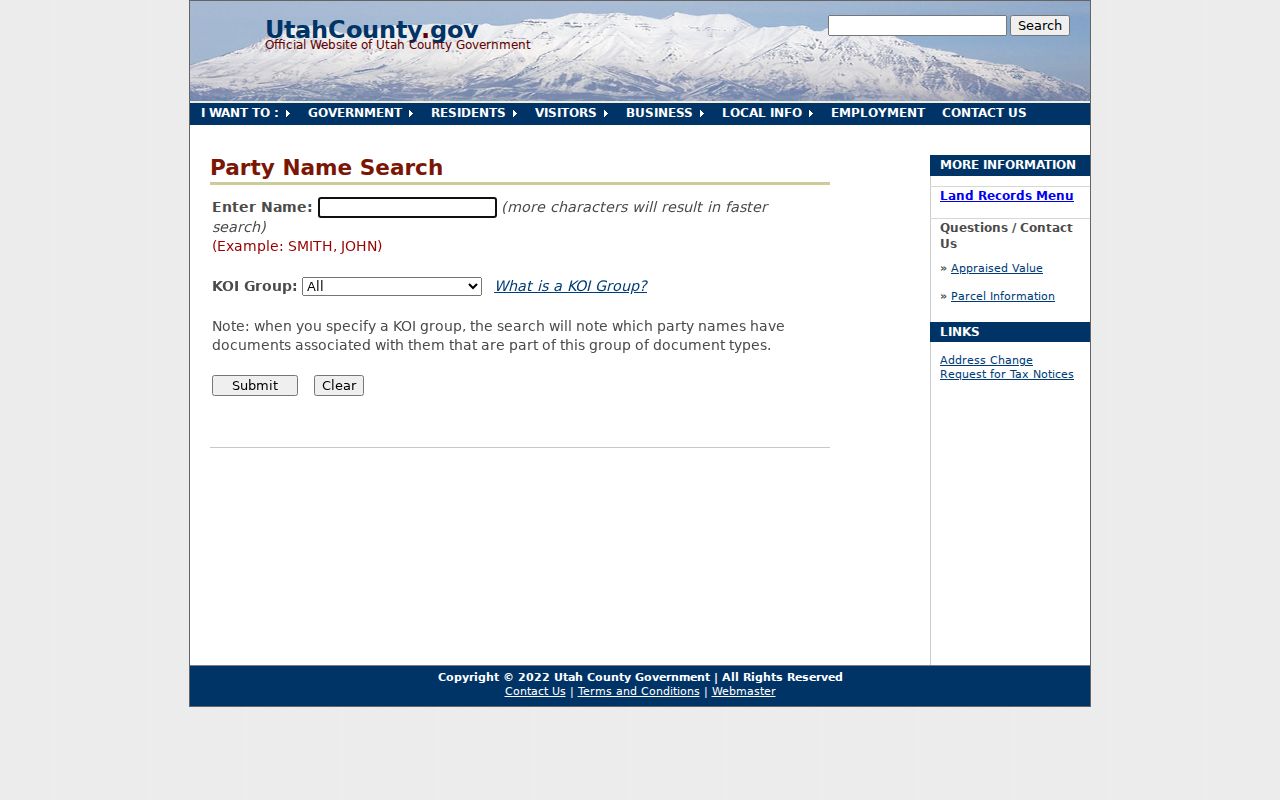
The captured form makes clear that a name search and an instrument-group filter are separate choices. Official record books begin in 1870, but computerized party-name coverage starts in January 1978. Earlier names require the handwritten alphabetical index at the Recorder's office.
Utah County Address Fields Compared
One Utah County parcel can show three address clues, and they do not mean the same thing. The situs address is the physical site. The owner mailing address is where the tax notice goes. CARE_NAME identifies a designated tax-bill recipient who may not own the parcel. Treating all three as one current home address can merge two people or place someone at land where they never lived.
This difference is especially useful when tracing a move or an estate. Compare the current owner, mailing city, vesting document, and parcel history. A trust or business name may replace a person's name. Some farm tracts, remnants, and narrow parcels have no street address at all, so a blank situs field is not proof that the parcel is false. For a fast comparison, use situs to connect a known street to land, owner mailing to find a possible later contact area, and CARE_NAME to spot an agent, relative, or manager.
The Utah County owner-name form offers All Records, Current Records Only, and Never Valid Only scopes.
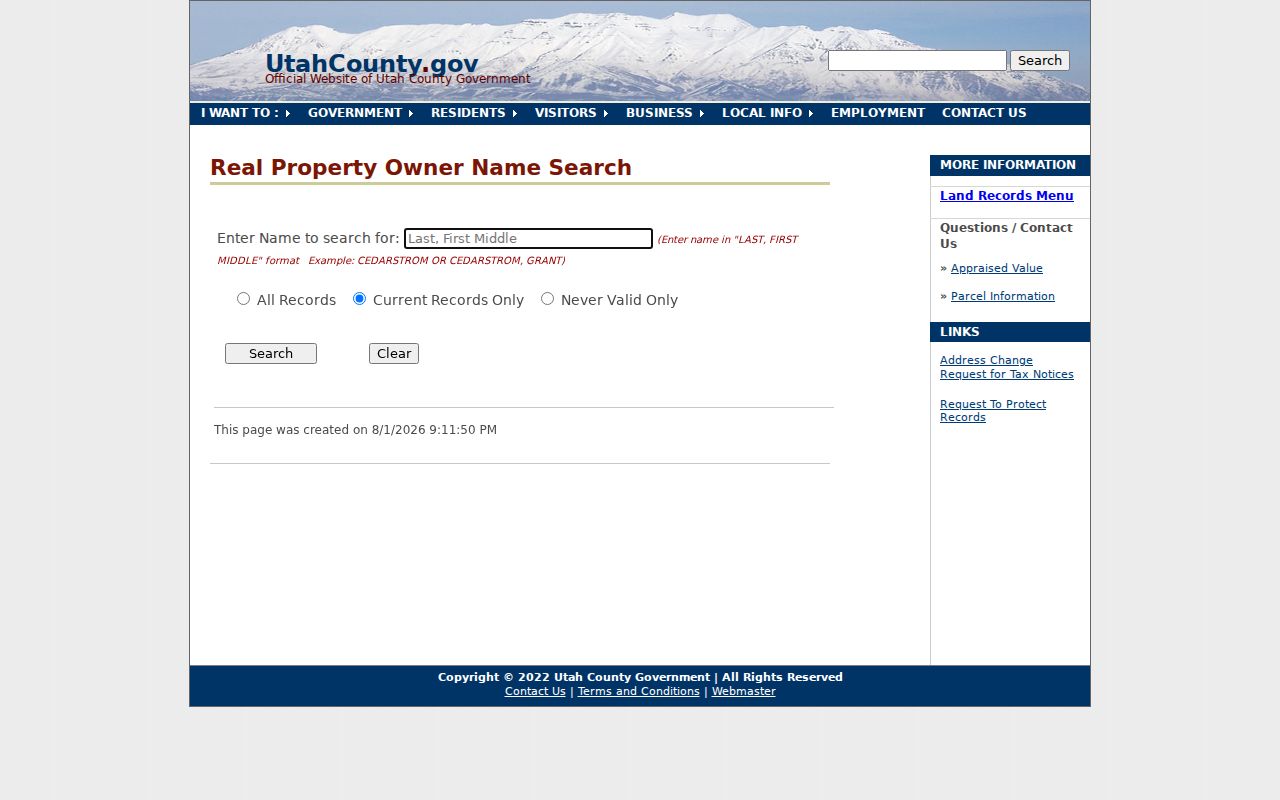
Those scopes let a searcher move beyond the current tax roll to invalid or prior serial records without claiming that an old entry proves current ownership.
Map a Utah County Address Search
A street address can become a name through the county parcel map. Search by address, partial owner, city, parcel serial, or the Public Land Survey System location. Once a parcel is selected, compare its serial, city boundary, tax district, deed point, and historic layers. The nine-digit serial encodes map book, page, and parcel, which helps when street data is missing or has changed.
The map is a reference tool, not a legal survey. Its historic date marks entry into the online property system, not the day a deed was recorded. For title history, follow the vesting document and abstract into the Recorder index. For a split parcel, track the serial history instead of searching only the current street number. Property Notification can draw a buffer up to one mile and export nearby owners, but it is not a residential phone directory.
The Utah County Parcel Map displays the serial, owner, address, city, and land-survey search modes.
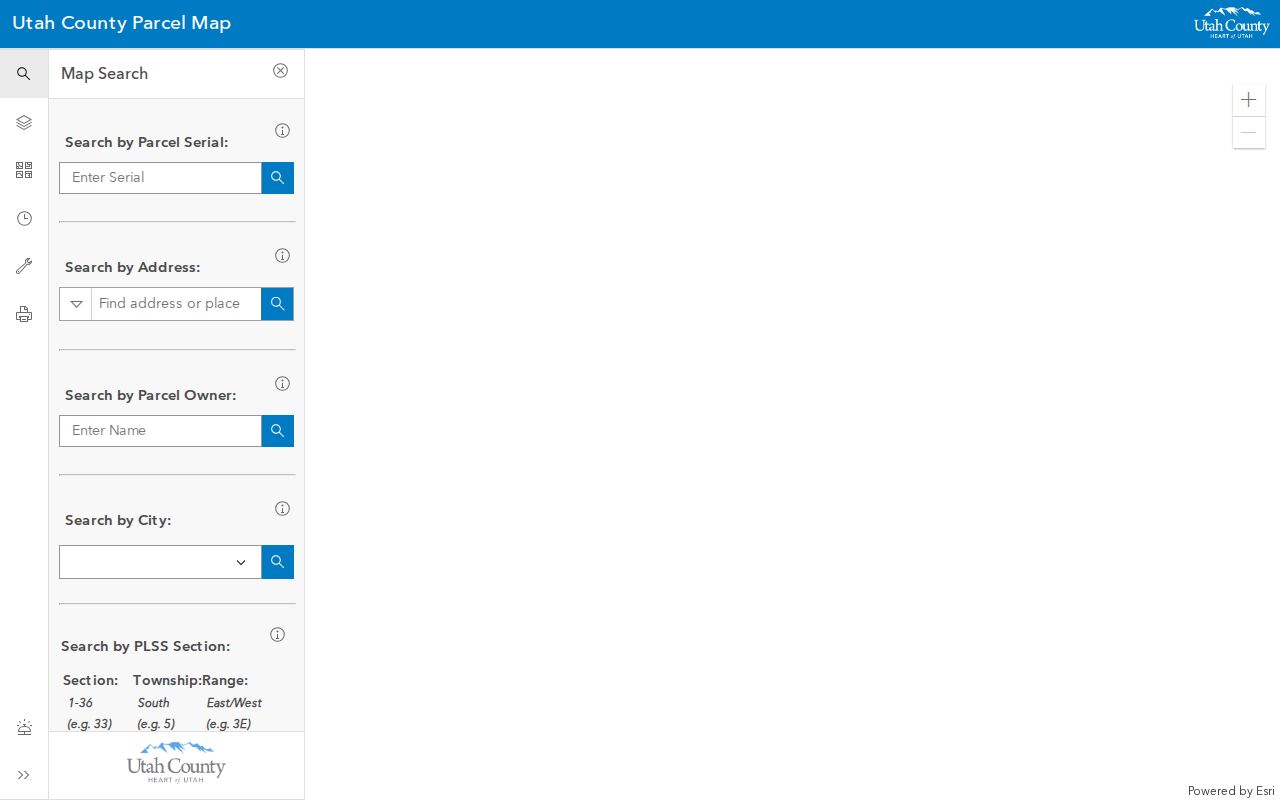
The captured map also shows why city boundaries matter. A postal city can differ from the agency with legal jurisdiction over a local record.
Utah County Court Name Lookup
Utah County court names are spread across Fourth District Court in Provo, Utah County Justice Court, and city justice courts. District court hears felony, larger civil, probate, and other district matters. Justice courts handle lower-level offenses, traffic, and small claims. American Fork District Court closed at the end of 2024, and its work moved to Provo. Federal matters use a separate federal case system.
XChange searches public Utah district and justice cases. A user can choose district, justice, or both; search all cases or judgments; and narrow by name, case type, county, court, date, birth date, or citation. Results may show the party's role, filing date, charges, plea, disposition, judge, counsel, and case history. Not every case displays every field.
| Court trail | Typical Utah County matters | Access route |
|---|---|---|
| Fourth District | Civil, felony, probate, domestic | XChange, clerk request, Archives |
| County and city justice | Small claims, traffic, lower offenses | XChange or the court |
| Federal district | Federal civil and criminal cases | Federal case locator |
The official XChange help illustrates the search and result screens.
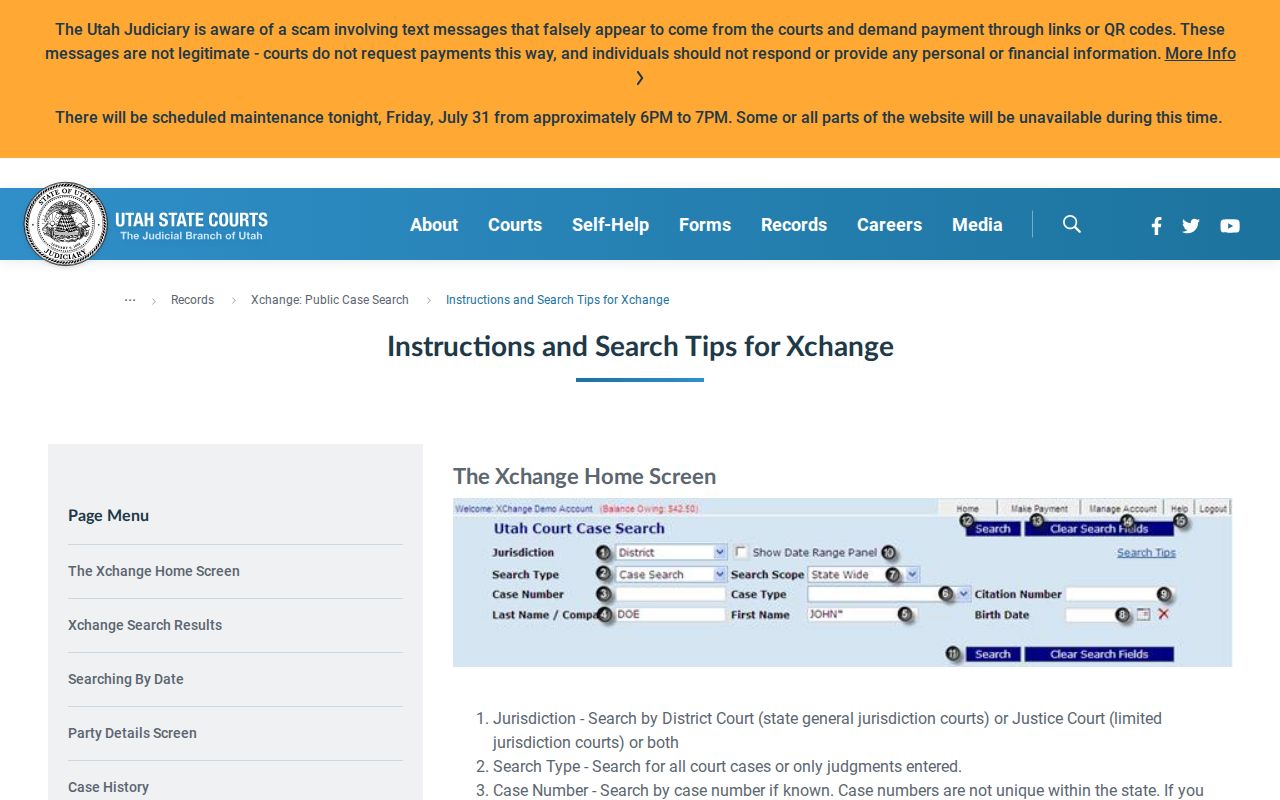
Remote access is paid, while XChange is free at most district courthouses and the State Law Library. Sealed, expunged, adoption, juvenile, and other private case classes will not appear as ordinary public results.
Read Utah County Probate Search Roles
Probate cases can connect a deceased person with heirs, guardians, representatives, and property. XChange role codes make those links more precise. DEC means decedent, HER means heir, PET means petitioner, and RES means respondent. A docket is the court's running list of filings and events. It can identify useful public orders even when a full case file has moved to the State Archives.
Territorial probate courts handled estates before statehood in 1896. After statehood, probate moved to district court. Search recent names through the court system, then use the Utah County Fourth District probate index and archival request channels for older cases. Adoption files remain closed, and some guardianship material is private, so a missing personal detail may reflect a legal limit rather than a failed name search.
- Docket
- The dated court list of filings, hearings, and case events.
- Decedent
- The person whose estate is being handled.
- Heir
- A person shown in the case as having a claimed or legal interest in the estate.
- Certified copy
- A copy carrying the court clerk's formal certification.
Note: Provo's first purpose-built courthouse and jail served only five years before the woolen mills acquired it.
Choose Utah County Vital Records Paths
Recent Utah County birth and death records are certificate requests, not open name indexes. The county Health Department accepts qualifying in-person and mail orders. The state vital office is another route. Recent certified copies are limited to the subject, immediate family, a guardian, or a legal representative, and proof of identity or relationship may be required.
Marriage and divorce follow different custody lines. The Utah County Clerk keeps the original county marriage license. The state offers limited-year marriage and divorce abstracts, while the Fourth District Court keeps divorce files. An abstract is a short state summary, not the complete application or decree. Older public material moves toward the State Archives after the agency's aging periods.
For family history, Utah County's digitized collection includes 1898 through 1905 birth registers, death registers, and marriage applications. Those are historical registers, not modern certificates. Page numbers in the old marriage indexes restart, so pair a name with the date and image instead of treating one page number as unique.
Search Utah County Marriage Records
The county marriage index needs a last name and accepts an optional first name. Search each spouse under the name used before marriage. The result set covers licenses issued by Utah County, not every ceremony held within county lines. Someone married in Provo under a license issued by another Utah county belongs in that issuing county's files.
Since 2020, a Utah County document may bear both “Marriage License” and “Certificate of Marriage,” and the Clerk may issue a digitally verifiable certified PDF. The original still remains with the Clerk. Historical applications can carry parents, birth details, and prior-marriage facts, but recent application details are private even when a public name-index hit exists.
Can a public index replace a certificate? No. An index helps identify the right Utah County license. A certified copy is the official record supplied by the custodian, subject to its order rules and fee.
Check Utah County Jail Records
The county jail search covers recent local bookings. It accepts a name in last-name-first format, an arrested date, or a Current Inmates choice. Results can show arrest, booking, release, agency, and status. Data may take 24 hours to appear. The Sheriff's page gives inconsistent retention descriptions, stating two years for name coverage while other text says photos remain 30 days and booking data one year.
A booking is an event, not a conviction. Verify charges and dispositions through the court record. The Utah corrections lookup covers current prison, probation, and parole status, while the county tool covers local jail custody. A person absent from one may be present in the other or outside the county site's publication window.
The Utah County inmate search shows the name, arrest-date, and current-inmate choices.
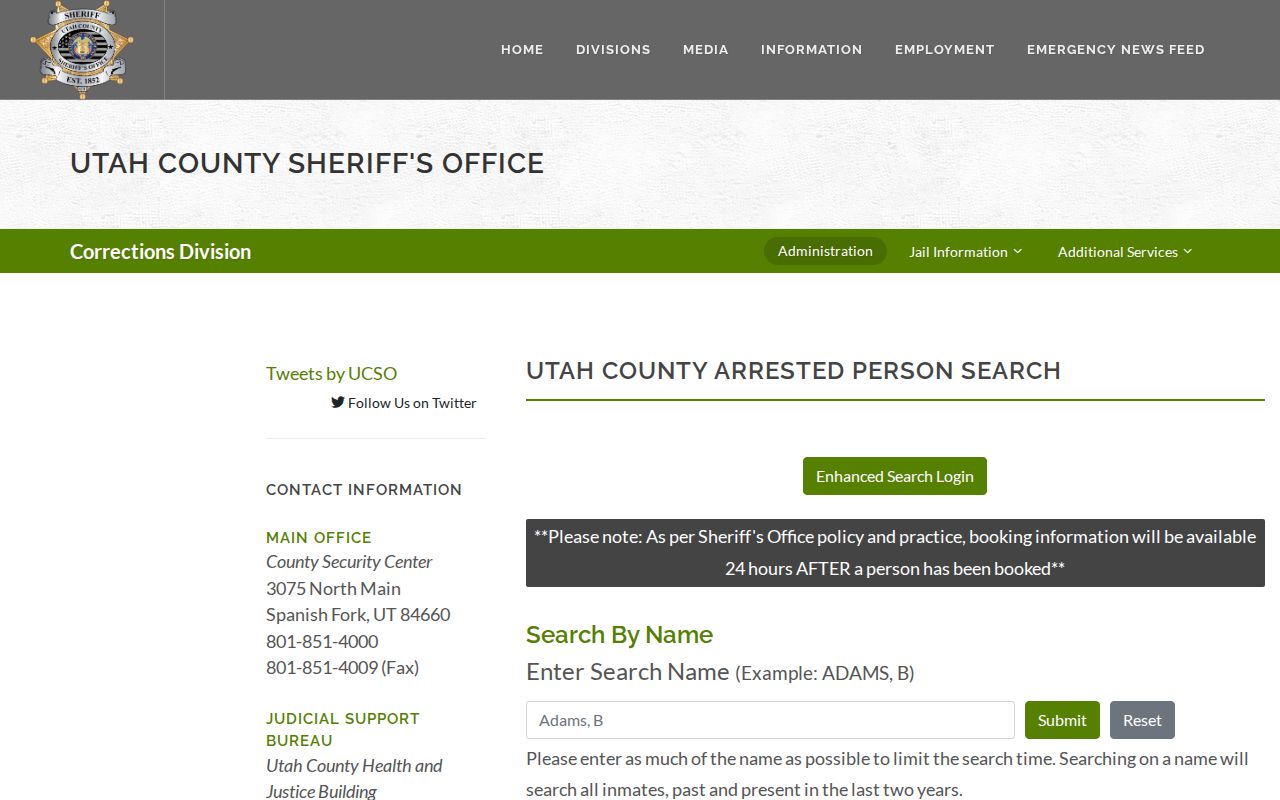
The separate controls distinguish a current roster check from a name search across the published recent period. Sheriff incident reports and media require a specific records request because the booking index is not the report itself.
Verify Utah County License Names
A professional name may lead to a statewide Utah license record. DOPL supports a name-and-profession route or a license-number route. The name search can use BEGINNING WITH or CONTAINING and can narrow through a profession hierarchy. Results identify the profession, license type, number, status, issue and expiration dates, and any published discipline or docket link.
This record verifies a license, not a personal address. Address and phone data are generally excluded unless a statute creates an exception. For a business principal, use the state corporations search instead. That system can connect a person with an entity, registered principal, trademark, or UCC filing, but each result should be read in its own filing context.
The Utah DOPL license lookup shows both the name-match and license-number routes.
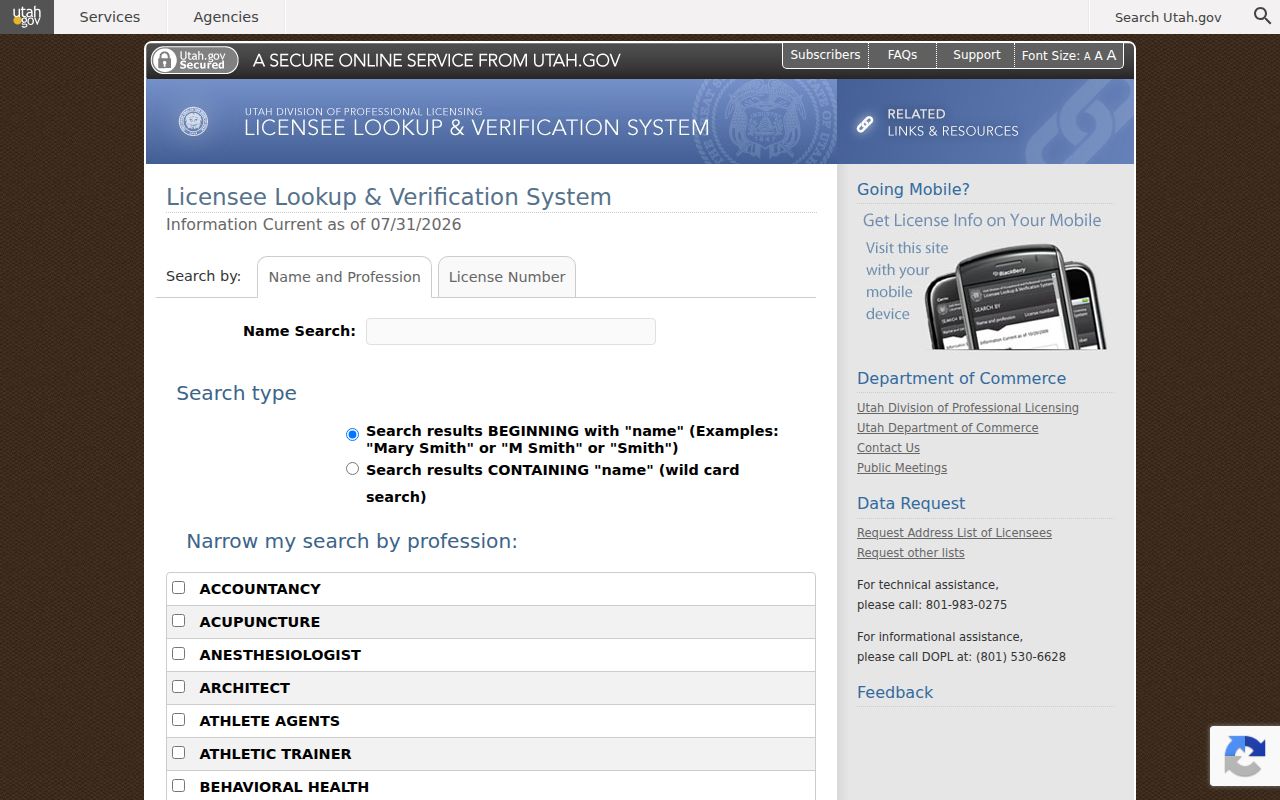
The profession filters help separate people with similar names and show why a bare name match should not be treated as a unique identity.
Know Utah County Voter Search Limits
The state Check My Status tool is for a voter's own registration status and polling location. It is not an open search box for browsing another person's record. Public voter data comes through paid state or county files. Those files may include a legal name, age range, addresses, party, districts, active or inactive status, update date, and elections in which the person took part.
Participation history never reveals a ballot choice. Full birth dates, government ID numbers, Social Security numbers, email, phone, and signatures are universally protected. Utah's 2026 At-Risk classification adds wider protection for qualifying people and co-residents by withholding or anonymizing identifying data. A missing name may therefore reflect a privacy classification, not a gap in registration.
The full distinctions, file formats, and county request route are covered in the Utah County voter registration search.
Note: An election participation field records that someone voted, never the candidate or measure selected on the ballot.
Search Utah County Archive Names
When modern portals stop, the Utah State Archives Name Index can search a partial name or keyword without wildcards. Its Browse Names route separates surname and first name. Some entries link to digital images, while others lead to a copy order. Relevant series span vital registers, courts, probate, naturalization, land, military, and cemetery material.
Utah County was organized in 1850, and formal county officers appear by 1852. Yet the Recorder's physical series begins in 1870. That gap does not mean earlier people left no trace. Census schedules, territorial court and probate material, newspapers, church sources, and town records may carry names before standardized county series began.
The Utah Archives name indexes show both Search Names and Browse Names paths.
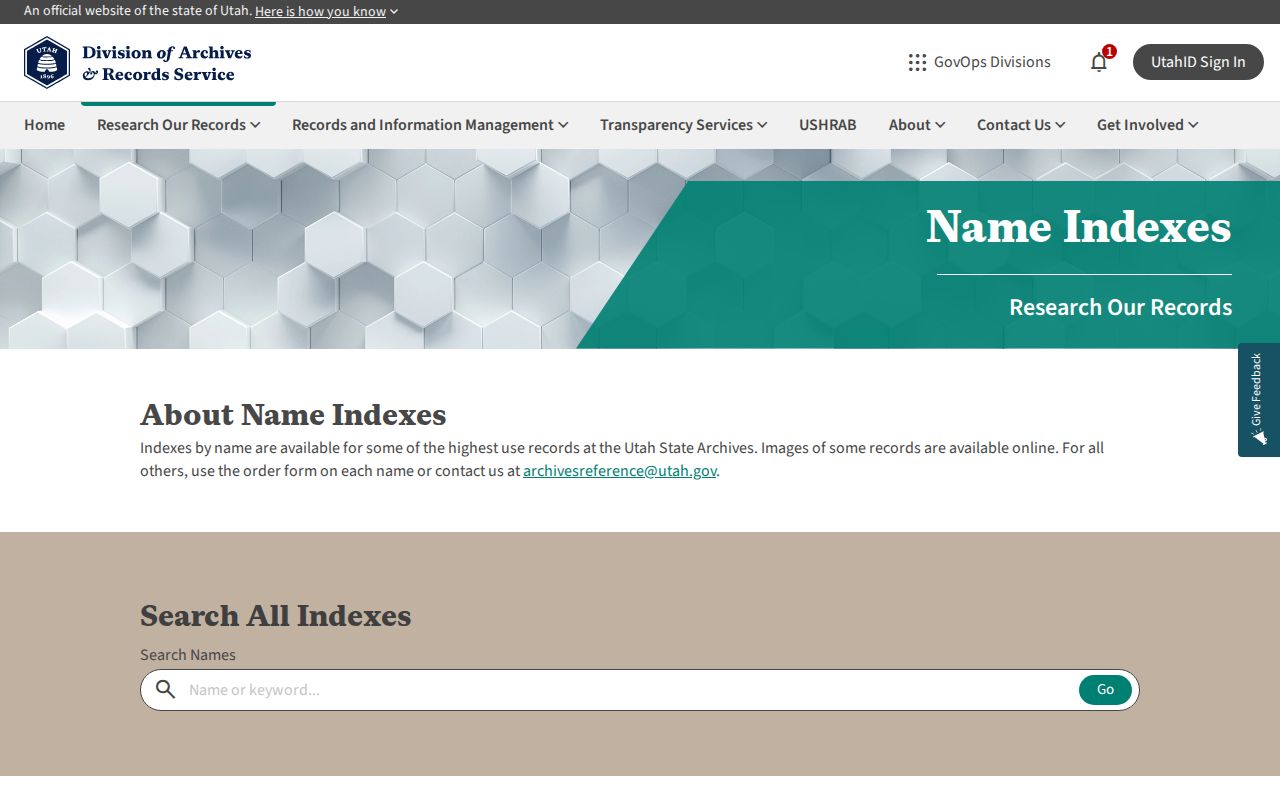
The two paths support different work: a broad partial-name query can surface a series, while surname browsing can help with spelling variants.
Translate Old Utah County Addresses
An old Provo address may look wrong even when the directory entry is sound. Provo changed its street system in 1902. Lettered north-to-south streets and numbered east-to-west streets became the modern scheme. J Street became Academy Avenue and later University Avenue. Searchers must try the street name used at the time before concluding that a household disappeared.
The Provo Library holds a 634-page 1884 Utah gazetteer plus a discontinuous Polk's Provo City and Utah County Directory run from 1917–18 through recent years. Cross-reference editions are confirmed for 1950 and 1953. An alphabetical directory moves from name to address. A cross-reference directory runs from address to occupant. Missing shelf years do not prove a person was absent.
The Provo Library local-history holdings list the exact Polk volumes and the early gazetteer.
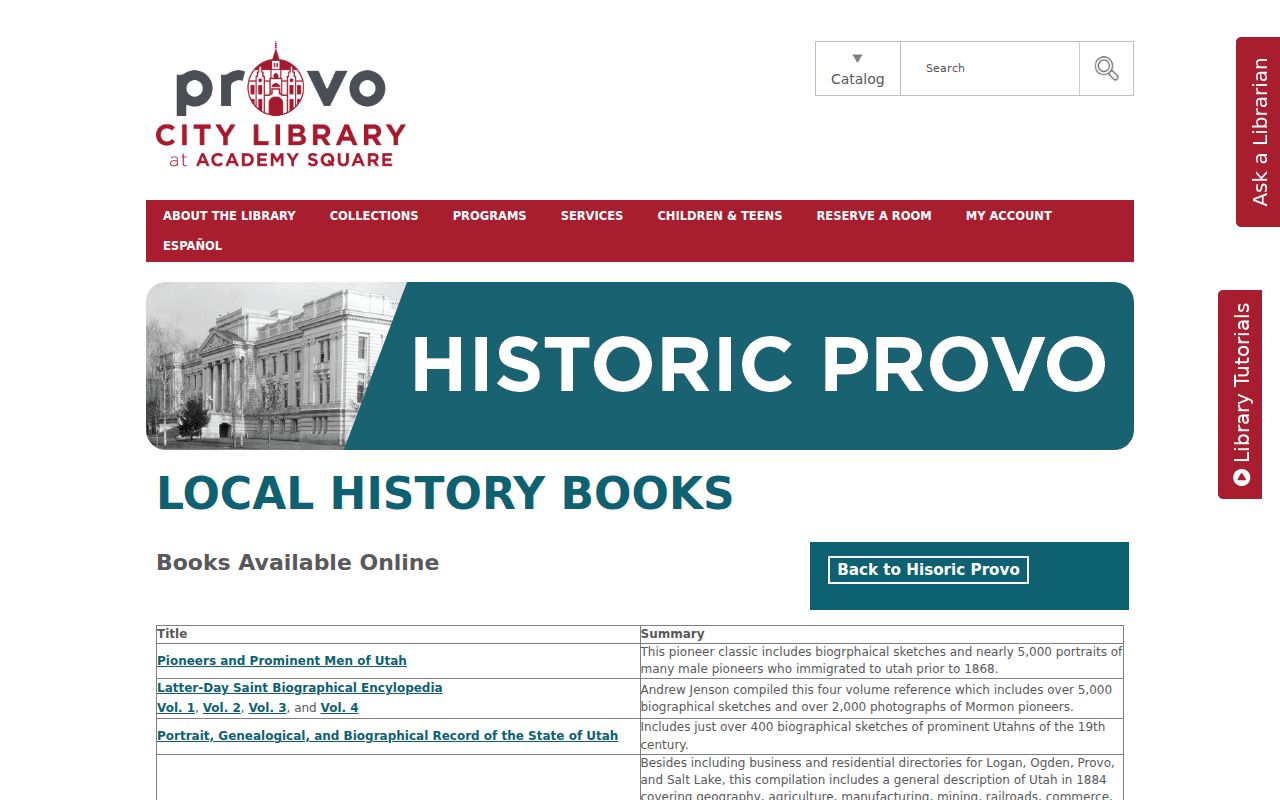
The shelf list gives an exact year check before a visit and prevents a search from relying on a volume the library does not hold.
When Utah County Records Go Offline
Use a fallback chain before declaring a dead end. The Recorder's online party index stops at 1978, but handwritten alphabetical records reach 1870. XChange coverage begins when each court adopted its case system, and older court files may sit at the Archives. The obituary index gives only a newspaper title and date, so microfilm or a digital newspaper source is the next required channel.
For a non-indexed county record, GRAMA provides the written route. Name the office, describe an existing record with reasonable detail, choose inspection or a copy, and give a cost ceiling. Utah County's online form also asks for contact details, any fee-waiver or expedited basis, restricted-record standing, and a photo ID upload. An ordinary response is due within ten business days; a qualifying expedited public-benefit request uses five.
Official sources and commercial compilations also serve different roles. County and state indexes expose the custodian's current classifications, dates, and request choices. A compiled people-finder result may blend old addresses or people with similar names. Use it as a lead only, then verify each claim against the Utah County record that created it.
| Search route | Strength | Best fallback |
|---|---|---|
| Official online index | Direct custodian context | Office counter or file request |
| Historical index | Older names and citations | Image, reel, or archive copy |
| Commercial compilation | Broad lead across sources | Confirm at the official source |
Note: Ask for a named report, date span, parcel, or case instead of asking an office to research a person.