
Check Utah County Voter Registration
The official starting point is the Vote.Utah.gov registration page. Choose Check My Status to reach the self-service lookup. It is designed for a voter to confirm that person's own status and polling location. It is not a browseable directory of other Utah County voters. The direct lookup endpoint failed during the research inspection, so its current input labels and match rules could not be verified.
That gap matters. Do not guess which fields the live service will demand. Open the state entry page, follow the current button, and provide only the details the official form requests. If the route fails again, call the Utah County Elections office at 801-851-VOTE or visit its Provo counter. Staff can help a voter check a personal record, while public list requests follow a separate process.
| Lookup control | Confirmed use | Access | Research status |
|---|---|---|---|
| Check My Status | Personal registration status | State entry page | Confirmed |
| Polling location result | Personal election location | After identity match | Confirmed |
| Exact identity fields | Identity verification | Live lookup | Not captured; verify live |
The state voter registration entry is shown in the captured official route below. Its page separates checking status from registering or updating a record.
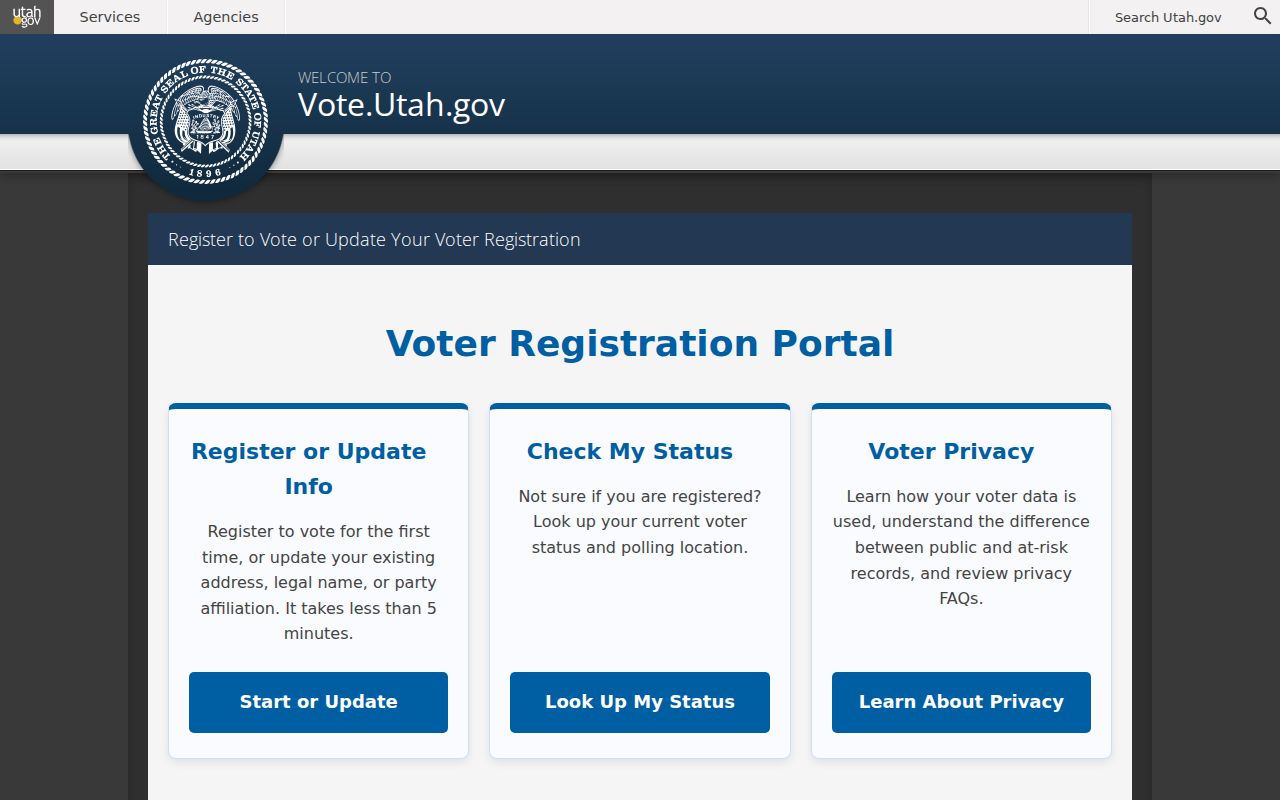
The screen confirms where self-lookup begins without supporting claims about fields that could not be inspected. Keep personal status checks distinct from voter-file orders.
Utah County Voter Record Fields
Utah Code §20A-2-602 divides voter information into public and protected groups. An ordinary public product may include a full legal name, voter ID, age range, residence and mailing addresses, county, precinct, party, registration status, last update date, and districts for Congress, the Legislature, school boards, county government, and a city council. Participation history can list elections in which the person voted.
A field may describe civic geography rather than personal identity. Precinct and district columns tell which contests applied to the record. Active or inactive status describes list administration. Neither field proves where someone currently spends each day. Address information can also be absent when a voter receives legal protection.
| Name and voter ID | Identifies the voter record |
|---|---|
| Residence and mailing | Public unless a privacy classification applies |
| Age | Age range may be public; full birth date is protected |
| Party and districts | Affiliation plus precinct and represented districts |
| Participation | Elections participated in, never ballot selections |
| Status and update | Active or inactive status and last record update |
Utah Voter Privacy in 2026
Every public voter product omits a full date of birth, driver license or state ID number, Social Security number, email address, phone number, and signature. Utah's 2026 SB 153 added an At-Risk classification for qualifying people, including listed victims or threatened people, certain law enforcement personnel, protective-order subjects, service members, public figures, and qualifying co-residents. Their personally identifiable voter information is withheld or anonymized.
The state voter privacy explanation distinguishes ordinary public fields, universally protected fields, and At-Risk records. Limited aggregate facts about geography, age, party, or history may remain without exposing an At-Risk identity. A voter can still see a private or withheld personal record through self-lookup even when it does not appear in a public file.
Confidential under Utah law. Utah Code §20A-2-602 protects full birth dates, government ID numbers, Social Security numbers, emails, phones, signatures, and identifying At-Risk data.
Request Utah County Voter Data
A Utah County Public Service Request, or PSR, is the practical route for a county subset. The order can include three CSV files: a voter list, a participation-history list, and a precinct-and-district list. History is available from 2015 forward when selected. The state generates the files and sets the invoiced charge. The county describes about two business days for generation after the request and sends the paid product by email.
Begin with the Utah County Elections voter-information page. The office is at 100 E Center, Suite 3100, Provo, open weekdays from 8 a.m. to 5 p.m. It can also be reached at 801-851-VOTE or elections@utahcounty.gov. County staff can explain the current invoice and request channel. There is no refund after the file is sent.
- Choose a current voter list, history from 2015 forward, and the precinct or district file as needed.
- Send the county request and wait for the state-generated invoice.
- Pay through the stated channel, then save the emailed CSV files with their field notes.
Obtain Utah's Statewide Voter File
The Lieutenant Governor's voter-data service sells a current statewide registration snapshot for $1,050. Delivery is a download link by email, usually within one business day. The tab-delimited file is about 150 MB. It can exceed what spreadsheet software will display cleanly, so preserve the original data and use a tool that can read the full row count.
The state does not sell a county or district slice of that product, does not include free updates, and does not refund the order. Utah County users who need only local rows should request the county PSR. Statutory pauses can also affect which snapshot is current, so record the product date when comparing two voter rolls.
The official order page captured below lays out statewide registration data and election-report choices.
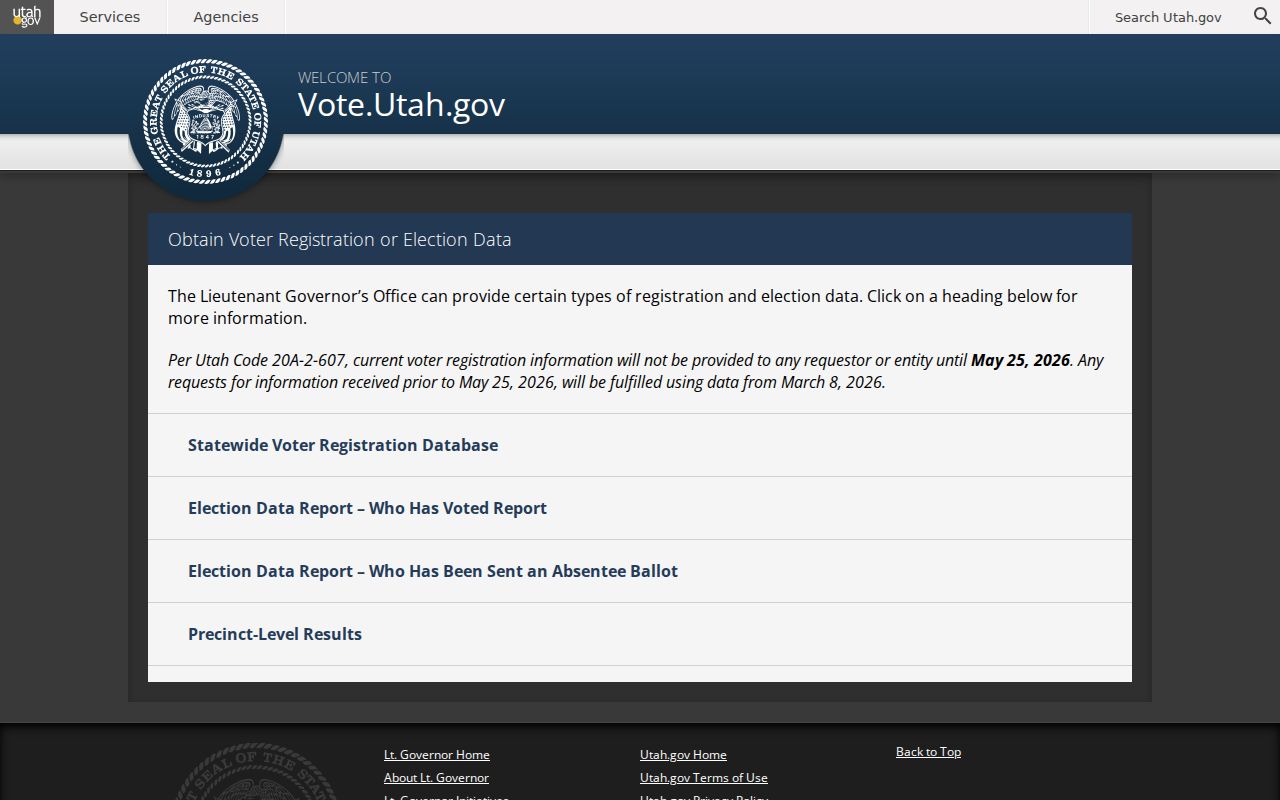
The screen reinforces a key distinction: a statewide database, a county request, and an election activity report are different products with different timing.
Utah County Vote History Limits
Does “Who Has Voted” reveal a choice? No. The report can state that a ballot was processed and may identify the voting method and date, but it never discloses a candidate or measure selection. Secret-ballot choices do not become voter registration fields.
Who Has Voted and Absentee Sent reports cost $35 per election under the current state description. They apply to regular even-year primary and general elections and arrive daily from 21 days before the election through election eve. They are not available for odd-year municipal elections or after the election. Precinct results are free, but those totals are aggregate results, not person-level ballot records.
A legacy Utah County request form still displays an older $15 amount. The current narrative and state product page say $35, so confirm the charge before payment. The county Has Voted form asks for requester identity and mailing details and whether the requester is a candidate.
The captured form shows those requester controls and the candidate yes-or-no choice.
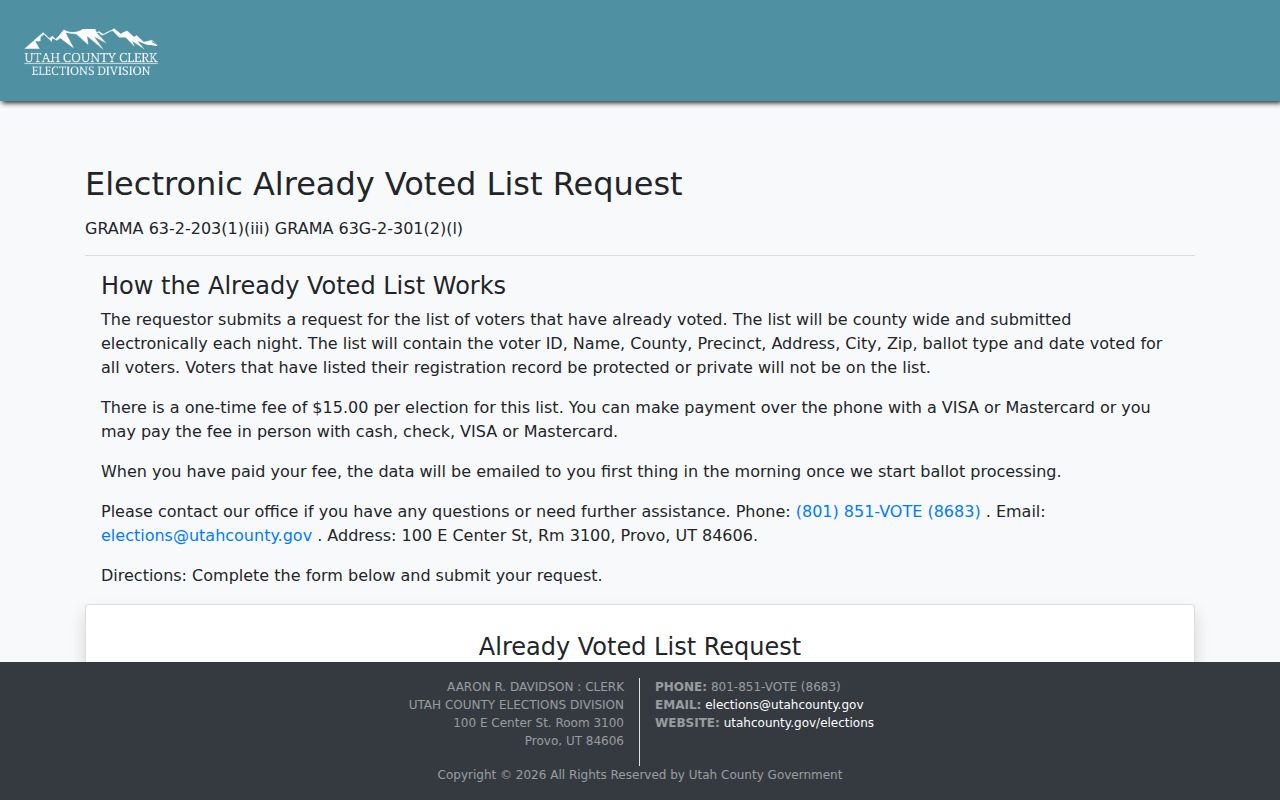
Because its displayed price conflicts with newer official text, use the form as an entry point and verify the live invoice before relying on the older amount.
Utah County Voter Status Changes
Inactive does not mean cancelled. Utah's published rule describes an inactive voter as someone who did not vote in two regular general elections and did not respond to a confirmation notice. Notices may follow returned election mail, inactivity, or information that a voter moved. A returned confirmation can update the record. Removals have separate reasons, including death, voter request, and eligible inactive cases.
The NVRA data page publishes monthly counts for confirmation cards and removals. Reason data begins in November 2025 and reports are retained for two years. These reports help explain list maintenance at a system level. They do not provide a substitute route around protected details in an individual voter record.
Utah County Voter Snapshot
A spring 2026 statutory pause held current data until May 25 and relied on a March 8 snapshot. That timing shows why two files ordered weeks apart may not describe the same list state. Always retain the order date and product notes with any count or comparison.
A statewide citizenship review released May 27, 2026 examined active and inactive registrations. Its Utah County result reported 99.78 percent confirmed and 0.22 percent unconfirmed, with 11 confirmed noncitizens and two likely. Those are review totals, not a directory of named voters. Utah also plans a new voter system in 2027, making version and date notes even more useful.
Historical Utah County Voter Records
Current research did not establish authoritative Utah County poll-book or registration-register year ranges. That is a documented gap, not proof that historical voter records do not exist. Start with Utah County Elections for retained local series, then ask the Utah State Archives whether a named election, precinct, and date range has been transferred.
Geography also changes the request. Countywide administration coexists with separate municipal elections in Provo, Orem, Lehi, American Fork, Spanish Fork, and other cities. An odd-year city election may have a different keeper than a statewide voter product. Give the custodian an election date, municipality, precinct if known, and the exact record type instead of asking broadly for every old voter list.
Use Utah County Voter Data Lawfully
Use public voter information for lawful civic and personal research. Never use it to stalk, threaten, harass, or evade an address protection. Utah's stalking law, §76-5-106.5, can reach a repeated course of monitoring, unwanted contact, surveillance, or acquiring and spreading information that causes reasonable fear or emotional distress.
Do not infer a ballot choice from party, status, precinct, or participation. Verify any disputed record with Elections, and respect withheld fields as deliberate safeguards. General agency access rules differ from election-specific law; the Utah County public records overview explains GRAMA requests without treating GRAMA as a way around voter privacy.
Safe use. Public access never authorizes intimidation or efforts to identify an At-Risk voter whose information Utah law withholds.