
Directory Choices Across Utah County
Utah County people directories are split by the group or fact they record. A public worker may appear in a city, school, university, or state directory. A parcel owner appears in county land tools. Licensed professionals and business principals have separate statewide search systems. Past residents turn up in library volumes, obituary citations, cemetery files, and archives. No one directory combines all of those groups, and Provo listings do not cover every city in Utah County.
| Directory source | People or roles listed | Record keeper | How to reach it |
|---|---|---|---|
| Provo Staff Directory | City offices and some named staff | Provo City | Free online search; department phone fallback |
| Utah State Employee Directory | State workers | State of Utah | Free online name search |
| Provo School directory | District administrators and CTE staff | Provo City School District | Free online search and cards |
| UVU directory | Employees and departments | Utah Valley University | Free search or department browse |
| Land Records | Current and former parcel owners | Utah County | Free web tools; office and manual-index fallback |
| Polk and gazetteer shelf | Historic residents and firms | Provo City Library | Library volumes; adjacent-year fallback |
Choose the source by relationship, not just by name. Use a government directory for an official contact, a school directory for a district administrator, and the property roll for an owner. For historical work, begin with the nearest available Polk volume, then confirm the address in a newspaper, census, deed, or obituary. The county's public records access details explain copy and request routes when a directory entry points to a source document.
Phone access also needs a clear line. No official, current residential white-pages directory was verified for Utah County. The state phone book covers government employees, while library holdings preserve older phone and city directories. Public alumni, congregation, neighborhood, union, and fraternal member rolls were not verified either.
Utah County Government Directory Lines
Government people directories differ sharply in scope. Provo's staff search accepts a category plus first and last names. Results can show a department, phone, and sometimes a named contact. It also mixes community resources into the same page, so it is not a complete city staff roll. Provo is only one municipality within Utah County. Orem, Lehi, American Fork, Spanish Fork, and other cities maintain their own contacts.
The county website mainly searches departments and returns office cards with addresses, phones, and email, not a full employee list. The Utah State Employee Directory is a separate statewide tool that requires both last and first name. It is for official contacts and states that the data is not a marketing list.
| Provo search field | Input type | How it narrows the directory |
|---|---|---|
| Category | Dropdown | Limits results by city service or department |
| First Name | Text | Pairs a given name with a surname |
| Last Name | Text | Finds named contacts by surname |
| Search | Button | Runs the chosen field combination |
The captured Provo directory controls show the paths offered before a search.
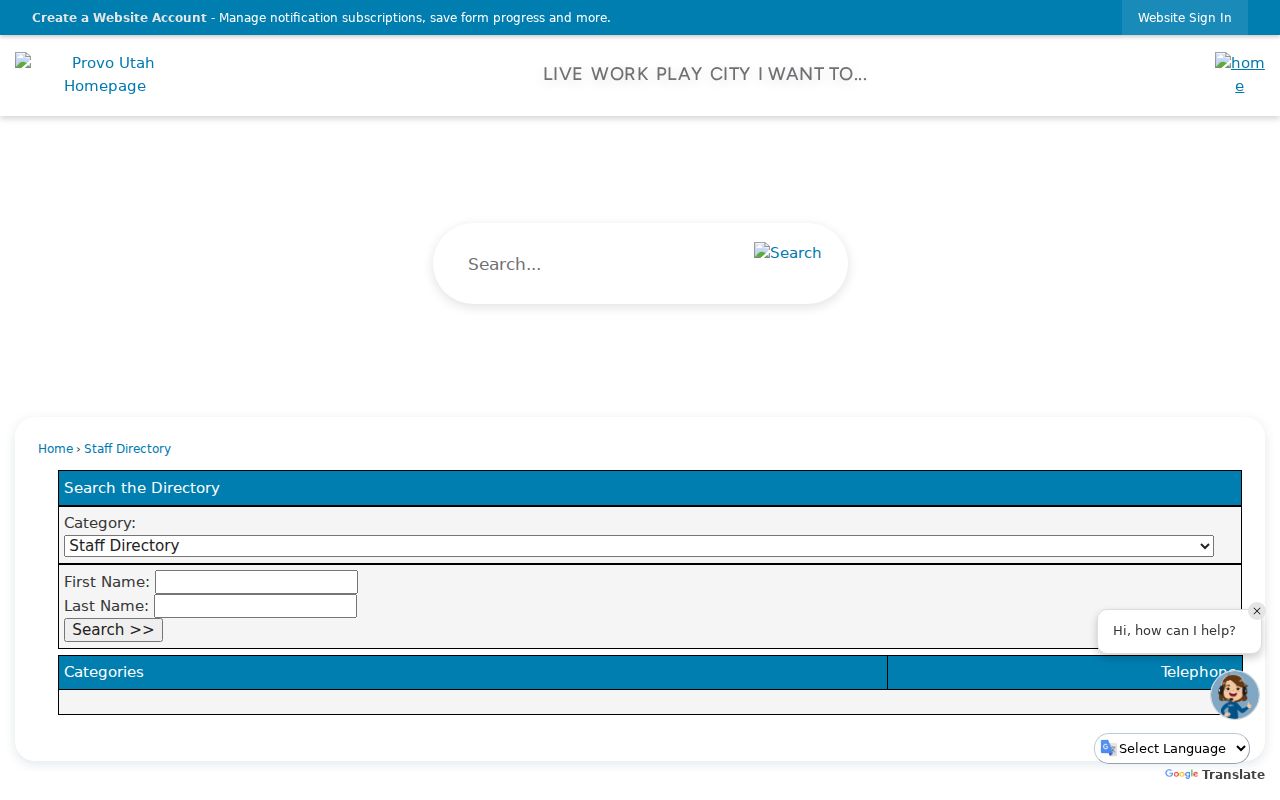
Category filtering helps when a common name produces several offices, while the department's main phone line remains the practical fallback when no person appears.
The Utah state directory interface makes its required two-field search and use warning visible.
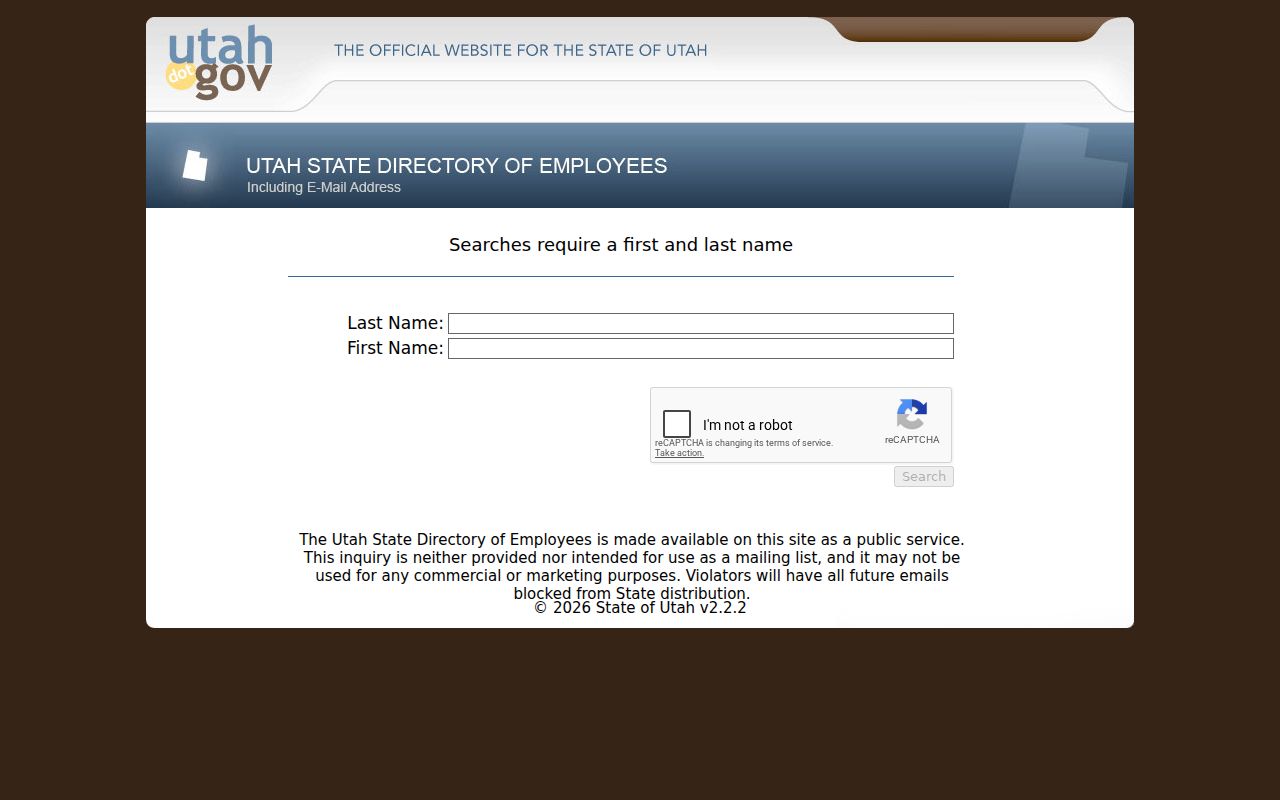
Because both name fields are required, an incomplete state-worker name may be better routed through the person's agency or department.
Note: A city listing describes that municipality, not all public workers across Utah County.
Utah County School Directory Routes
The Provo City School District Office Directory offers a “Search our staff” field and current contact cards. Its CTE directory also groups contacts by school and subject. A verified district card included a portrait, name, superintendent title, work phone, and an email link. Some cards omit a phone, so the district office remains the next access channel. These are current public contacts, not student, alumni, or historic educator lists.
| Entry field | What the directory may show |
|---|---|
| Portrait | Current staff image when supplied |
| Name | Named administrator or staff contact |
| Role | Title, school, or subject grouping |
| Phone | Work number when published |
| Direct email link when published |
The Utah Valley University directory uses one optional “Search by Name or Department” field, a Search button, and a separate department browse. BYU has a dynamic directory, but reliable fields and results were not captured in the research. For older campus names, BYU Special Collections and its yearbook or school ephemera descriptions are the documented fallback.
The live district directory illustrates the search box and contact-card layout.
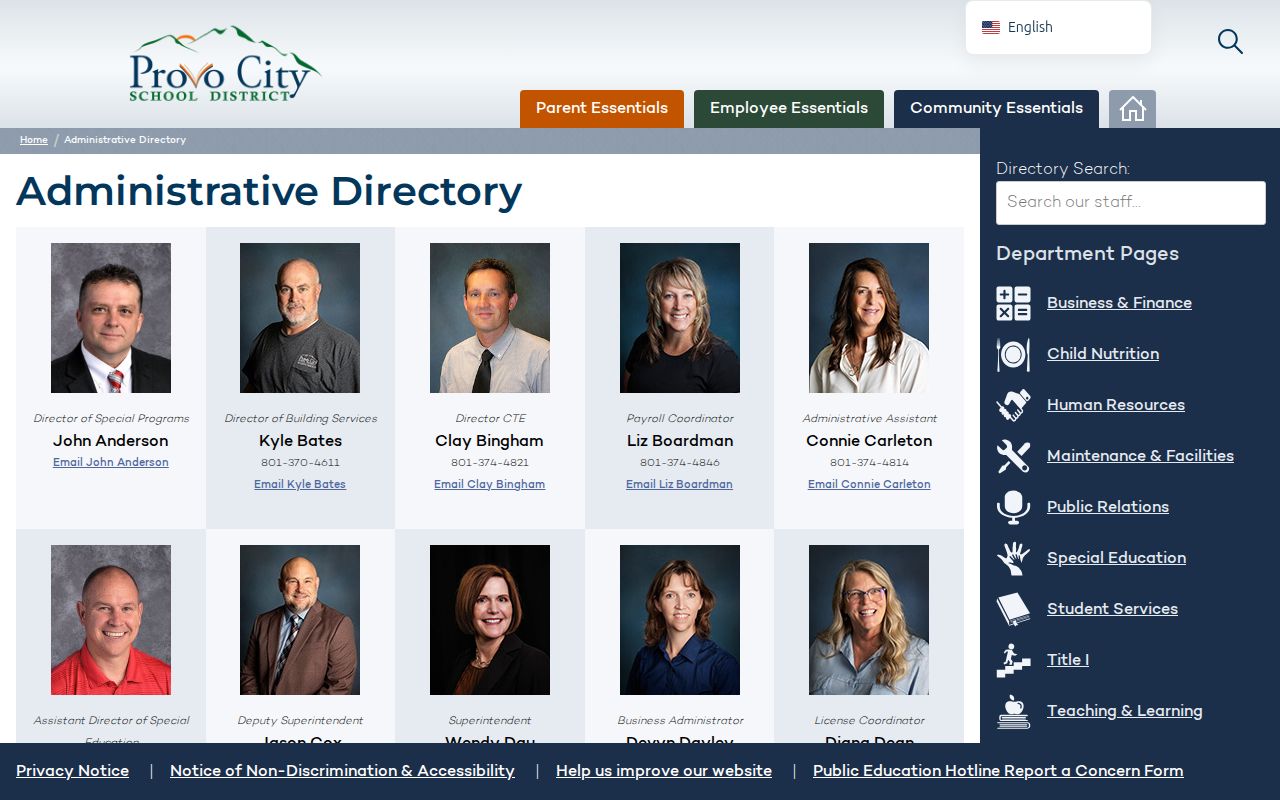
A title and direct work contact can distinguish two staff members who share a surname.
Utah County Land Name Directories
County land records work as people directories because they connect a party or owner name to land. The Recorder's party index searches a name in LAST, FIRST form and can narrow by a Kind of Instrument group. A grantor is a party transferring an interest; a grantee receives it. The computer name index begins in January 1978, but official record books reach 1870. Earlier names require the handwritten alphabetical index or help from the Recorder at 100 E Center, Suite 1300 in Provo, 801-851-8179, on weekdays from 8:30 a.m. to 5 p.m.
The owner-name directory accepts a surname alone or a fuller name. Its scope choices are All Records, Current Records Only, and Never Valid Only. That last history route can reveal a former parcel identity or owner that a current-only result hides. Recorder staff can locate records, but they do not perform title searches or interpret documents.
Three address fields are not interchangeable. The situs is the land's physical location. Owner mailing is where tax notices go. CARE_NAME identifies another tax-bill recipient who may not own the parcel.
Map-Based Utah County Owner Directory
The Utah County Parcel Map can locate property by serial, owner, address, city, or public-land survey position. It then connects a parcel to owner and land data. Layers add historic parcels, city boundaries, tax districts, school districts, deed points, and aerial photos. This is useful when an address lies near a city line or when a postal city does not settle which government serves it.
An unusually broad companion, Property Notification, lets a user pick a parcel, set a buffer as large as 5,280 feet, include or exclude the selected tract, and export surrounding property owners as a CSV. CSV means a simple comma-separated data file. It can aid heir research, boundary notices, or neighborhood history. It is not a residential phone directory.
Why can a valid parcel have no street address? Some agricultural tracts, slivers, or remnants lack a situs address. Search by serial, owner, deed point, or land description instead. Also, the map's historic date records entry into the online property system, not the date a deed was recorded.
Utah County Professional Directories
The Utah DOPL Licensee Lookup covers many regulated professions. Search by name and profession or by license number. The name mode can match words beginning with or containing the typed text, and the profession control uses a checkbox hierarchy. Results may list profession, license name, type, number, status, issue and expiration dates, and a discipline link or docket. Public results generally do not supply a home address or phone.
- Name and profession searches return license identity, type, status, and dates.
- A core number plus its four-digit identifier verifies a specific license.
- Construction registry fields include trade, company, license, city, state, and ZIP.
Utah's Construction Business Registry is narrower than the main DOPL directory because it includes active licensees who opted in. The Utah State Bar and voluntary Business Law listings offer other professional routes, but their dynamic fields were not fully captured. Ask the agency for certified verification when an official document is needed.
Business Directories Serving Utah County
The Utah Division of Corporations searches connect business entities, registered principals, trademarks, and UCC debtors with filings. UCC refers to commercial financing records under the Uniform Commercial Code. A principal-name result can link an individual to an entity, while a certified existence record answers a different question about the business itself.
The Utah Valley Chamber directory takes a keyword, one of 18 categories, or an alphanumeric browse choice. Its member cards show an organization, street address, phone, and website. Membership is voluntary. A missing chamber result does not prove that a person or firm has no business in Utah County. City business-license records also remain city-specific rather than forming one countywide directory.
Historic Utah County People Directories
Provo City Library's local-history shelf holds Polk's Provo City and Utah County Directory. Its discontinuous run includes 1917–18, 1920, 1922, 1926, 1929, 1930–31, 1935–36, 1939, 1941, 1944, 1946, 1950, 1953, 1955–62, 1964–65, 1967–80, 1982–85, 1987, 1996, 1998, 2000–02, and 2004 to the present. The library also holds a 634-page 1884 gazetteer covering Provo with Logan, Ogden, and Salt Lake City.
These Utah County people directories can place a resident or firm at an address and often show occupation or household context. The gap years matter. Absence from a missing volume proves nothing, so check the nearest years, census, deeds, and newspapers. If travel is not practical, contact the library about its local-history holdings, use the Utah Archives Name Index, or search digitized newspaper collections.
- City directory
- An alphabetical name-to-address volume, often mixed with business listings.
- Cross-reference directory
- An address-to-occupant arrangement, also called a reverse directory.
- Gazetteer
- A place and business reference that may also name residents or officials.
- Directory gap
- A year for which the local shelf does not list a volume.
Utah County Reverse Directory Quirks
Verified Provo cross-reference editions from 1950 and 1953 reverse the usual search: start with an address and find the listed occupant. The research did not establish a complete run beyond those editions. One local change can derail a search. Provo replaced its older lettered north-south and numbered east-west street scheme in 1902. J Street became Academy Avenue and later University Avenue.
Use the street name printed in the directory's own year. Then compare an old map, adjacent Polk volume, newspaper notice, property chain, and census enumeration district. That sequence keeps a later street name from being projected onto an earlier resident. It also separates a true address change from a simple change in the city's naming system.
Note: An alphabetical directory answers name to address, while the verified 1950 and 1953 cross-reference volumes answer address to occupant.
Utah County Memorial Directories
The Utah County Obituary Index covers county newspapers from the 1870s through the prior calendar year. It returns a newspaper title and date, not the obituary text. That makes microfilm an essential second channel. The library routes users to Daily Herald and predecessor reels, Utah Digital Newspapers, and other newspaper sources. Title runs overlap and contain gaps, so retain the exact citation.
Provo City Cemetery, established in 1853, adds a web map, State History burial records, and original sexton records. Its layers include lots, blocks, document scans, Baby Land, and Angel Garden. The office can assist by phone at 801-852-6607 or in person at 610 S State on weekdays from 8 a.m. to 4:30 p.m. Cemetery details can supply dates, birthplace, and plot location.
For broader Utah County people directories, the Utah Archives Name Index accepts a partial keyword or a surname-and-first-name browse. Some hits open images; others lead to a copy order. BYU's Family History Center provides another in-person access point for FamilySearch resources when images require sign-in or a center.
Note: Treat an obituary-index hit as a citation to retrieve, not as the full account of a person's life.