
Which Utah County Public Records Are Open
Utah's Government Records Access and Management Act, or GRAMA, starts with the office that maintains a record. It does not open every government file. Utah County land indexes, tax rolls, many court dockets, booking data, and state license searches have public routes. Recent certificates, sealed cases, and protected personal data follow other rules. A broad county request cannot replace a request to the office that holds the file.
| Record group | Keeper | Web coverage | Practical access |
|---|---|---|---|
| Deeds, liens, plats | County Recorder | Records from 1870; names from 1978 | Free index; manual books; paid copies |
| Property and tax | Assessor, Recorder, Treasurer | Current and historic serial data | Free land hub, map, office, GRAMA |
| Marriage licenses | County Clerk | Utah County-issued name index | Index, counter, phone, certificate order |
| District and justice cases | Utah Judiciary | XChange; most district data by 1998 | Paid web, free court terminal, file request |
| Birth and death | County Health, Utah Vital Records | No recent open-name index | Eligible order; aged records at Archives |
| Voter and election data | County Clerk, Lt. Governor | Own-status lookup; paid data products | Sensitive and At-Risk fields withheld |
| Jail and corrections | Sheriff, Utah DOC | Recent booking or current supervision | Free search; report request by custodian |
| Licenses and businesses | DOPL, Corporations | Statewide name searches | Free lookup; certified or data fees |
Access can stop at the index. A deed entry may be open while an unredacted image is limited. Court rules exclude sealed, expunged, adoption, juvenile, and some domestic files. Voter products omit protected data and At-Risk identities. A missing result does not prove that no record exists.
Utah County Recorder Records Span
The Utah County Recorder's holdings begin in 1870. Yet the computerized party-name index begins in January 1978. Older name work moves to the handwritten alphabetical index at the Recorder counter. Abstracts are handwritten or typed from 1870 through September 1985, while online abstracts begin in May 1980. REDI book images for 1976 and 1977 help bridge part of the period just before the computer index.
Start online at the free Land Records hub. A party-name search finds people or entities; a property abstract follows land; and a Kind of Instrument search narrows a document class. If the web route fails, visit the counter at 100 E Center, Suite 1300 in Provo, call 801-851-8179, or email recorder@utahcounty.gov. State Archives and the FamilySearch Catalog are further historical routes. Staff can locate records, but they do not perform title searches or interpret documents.
Note: Bring name variants, an approximate date, parcel serial, entry number, or book and page when asking staff to locate a record.
Search Utah County Recorder Records
The Recorder's party tool expects a name in surname-first form. More characters can speed a broad search, while the optional KOI Group control narrows results by the county's Kind of Instrument category. A separate recording search accepts either entry number and year or a date range. That distinction matters: the party search begins with a person, while the recording search begins with a known filing or time span.
| Field label | Control | Required | Format or use |
|---|---|---|---|
| Enter Name | Text | Yes | SMITH, JOHN; more letters narrow results |
| KOI Group | Select | No | Restricts by instrument group |
| Entry Number + Year | Text pair | One search route | Retrieves a known recording |
| Start Date + End Date | Date pair | Alternate route | MM/DD/YYYY |
| Book + Page | Text pair | Alternate lookup | Retrieves a known document location |
Recording results can show entry number, recorded date and time, fee, recorder or operator, page count, and an image link. An old browser plug-in warning on a legacy image page is not a current browser recommendation. For a non-routine retained record that ordinary copy service cannot supply, use a defined GRAMA request rather than asking the Recorder to conduct open-ended research.
Three Utah County Property Addresses
Utah County's parcel schema keeps three identity and address concepts apart. The situs is the physical site. The owner mailing address is where the tax notice goes. CARE_NAME is the designated person or entity that receives the tax bill, and that name is not always the owner. Treating all three as one address can attach the wrong person to a parcel.
The Utah County Parcel Map accepts a serial, address, partial owner name, city, or public-land location. The wider land hub also offers name, subdivision, appraisal, tax, delinquent-tax, payoff, and serial-history routes. Ask the Assessor about value or exemptions, the Recorder about ownership evidence, and the Treasurer about payments. Call the Assessor at 801-851-8295 when portal data needs office context; request a defined retained dataset through GRAMA if it is not published. Recorded deeds and reverse directories are the historical fallback.
Read addresses with care. A trust may appear instead of a person, a valid parcel may lack a street address, and tax mailing data does not prove who occupies the site.
Utah County Court Records Channels
Utah Courts XChange searches district and justice cases by party, case number, citation, court, case type, and date. Most district courts reached full coverage by the end of 1998, but justice court start dates vary. A remote one-time account starts with a $10 credit; the published rate is $0.35 per search and $1 for an eligible electronic document. Results cap at 500, so narrow common names by court, date, or date of birth when available.
Most district courthouses and the State Law Library offer free XChange; confirm a justice-court terminal first. Call Provo District Court at 801-429-1000 or Utah County Justice Court at 801-851-7200. After identifying a case, use the Judiciary record request for inspection, copies, certification, or a claim of standing to see nonpublic material. Cases over 50 years old may be at the Utah State Archives. Federal cases use the separate federal case locator.
Note: A blank search may reflect a private case, spelling difference, older file, wrong court, or a local court's later data conversion.
Utah County Vital Records Boundaries
Recent birth and death certificates have no open people index. The Utah County Health Department takes eligible requests in person at Provo, Saratoga Springs, or Payson, and by mail. The county says local mail processing takes about one week. The state vital office also takes orders, but its published mail guidance currently says to allow at least six weeks. Either route requires the proper form, fee, current identification, and proof of relationship or authority when needed.
The agencies state that birth records become public after 100 years, deaths after 50 years, and marriage or divorce records after 75 years. Public-aged records move to archival channels. The Utah County Vital Collection includes digitized 1898 through 1905 birth and death registers and marriage applications. For current files, subject, immediate family, guardian, or legal representative status controls certified access. An ordinary GRAMA form is not a substitute for the certificate application.
The Utah vital forms list shows the certificate applications and their separate purposes.
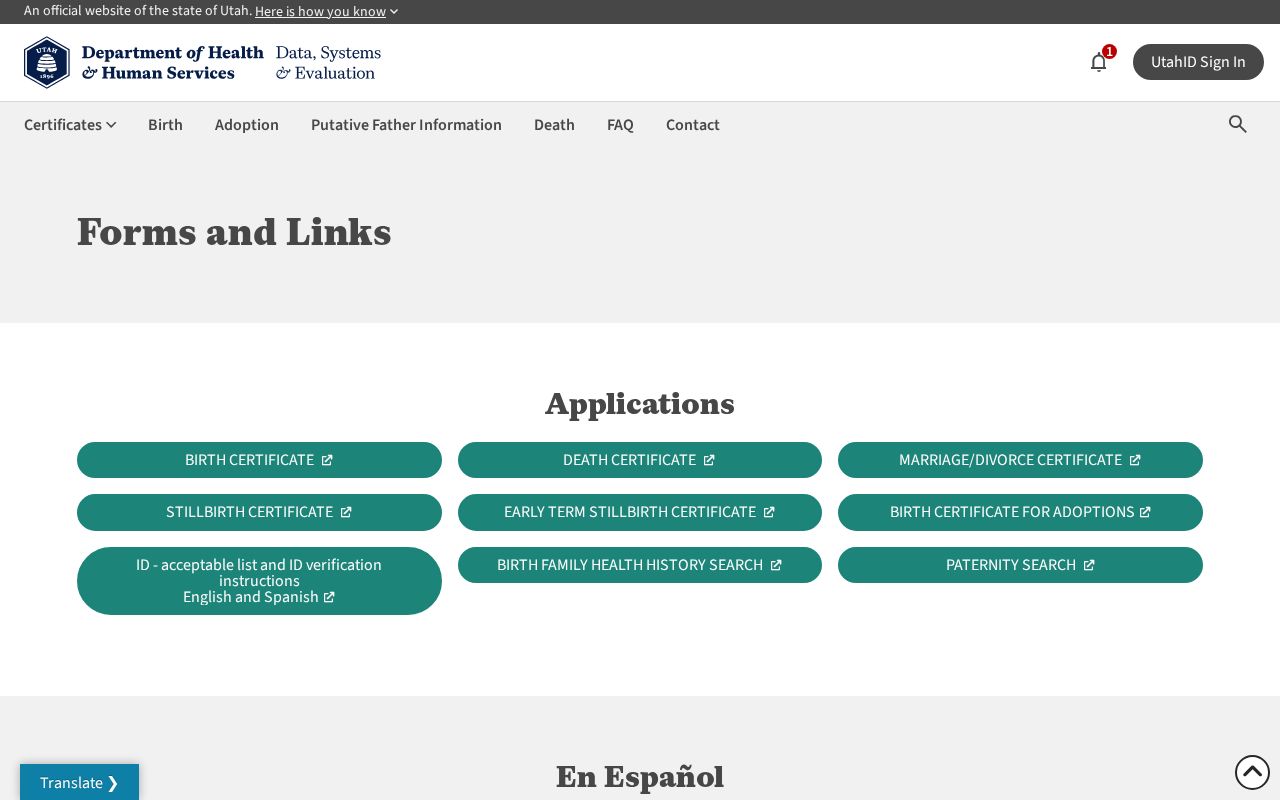
The form route makes the access boundary plain: searchers order an eligible certificate rather than browse recent names.
Utah County Election Records Limits
A voter uses the state Check My Status route for their own registration and polling place. Other public voter data comes through paid state files or a Utah County Public Service Request, not an open search of someone else's birth date. Public products may contain name, age range, address, party, districts, status, and elections participated in. They never disclose ballot choices. Full dates of birth, government ID numbers, Social Security numbers, signatures, phone numbers, and email addresses stay protected.
At-Risk classification under 2026 SB 153 withholds or anonymizes identifying voter data for eligible people. This is intentional privacy, not a missing record to work around. The Utah County elections request page identifies the county route for voter data and election reports.
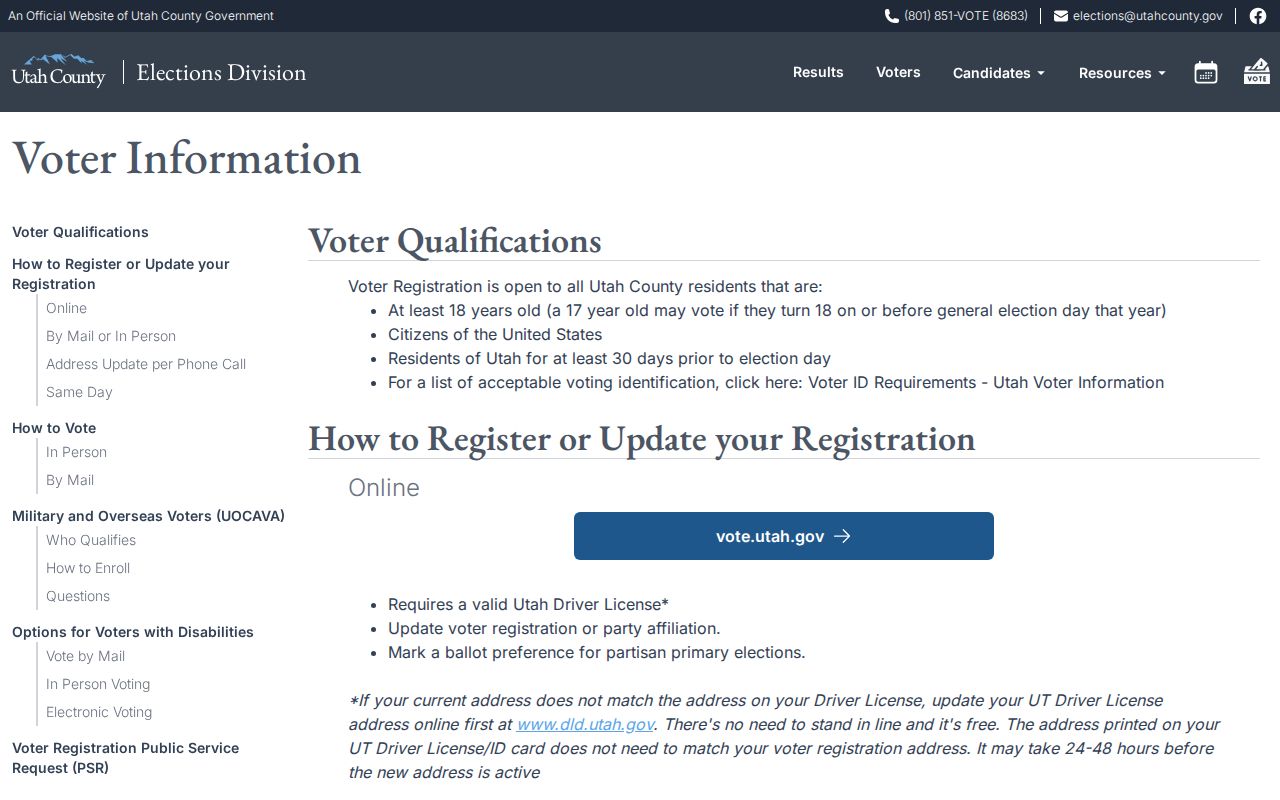
The county channel also keeps a self-lookup separate from public-data products, a key privacy line for any records search.
Utah County Public Records Offices
Custody is split among offices. The Recorder handles title documents and maps, the Clerk handles marriages and elections, and courts control case files under Judiciary rules.
Provo, Orem, Lehi, and other cities keep separate municipal files. A blank countywide search does not prove that no city record exists.
Utah County Booking Records Routes
The Utah County jail search accepts a name, arrest date, or Current Inmates choice. Data appears after 24 hours, and the page gives inconsistent retention descriptions: it mentions two-year name coverage while also describing shorter display periods for photos and other booking data. Treat the result as an event and status record, not as a court disposition.
The county jail, state corrections, and court dockets answer different questions. The Utah DOC Offender Search covers current prison, probation, or parole status, not pretrial county detention. VINE provides custody alerts, while federal custody has a separate locator. For a specified incident report or video, use the Sheriff records unit and its GRAMA form; the court holds charges and outcomes.
Note: Confirm an allegation in the court file and its disposition before drawing any conclusion from a booking entry.
Utah County Records Terms Decoded
A free index may identify a file without supplying its pages. Name the exact product when contacting a Utah County custodian to avoid a repeat order.
- Index
- A list used to identify a record, often by party, date, type, or file number.
- Image
- A scan of the filed document; access may differ from access to its index entry.
- Certified copy
- A copy authenticated by the office that holds the original record.
- Custodian
- The agency or office that maintains the requested record.
- Exemption
- A legal basis for withholding all or part of a record.
GRAMA generally bars a fee merely to inspect an open government record, but permits reasonable actual copy or compile costs. Courts use Judiciary rules and fees.
Utah County Parcel Date Quirk
The Parcel Map's historic date is when a parcel entered the online database, not when its deed was recorded. Use the vesting document, abstract, and recording entry to date title evidence.
Historic layers still help when land split or serials changed. Follow serial history, then retrieve the deed by entry number or book and page. The map is not a legal survey.
Utah County Records Copy Costs
Recorder copies cost $1 per page, certification adds $5, a screen printout is $0.50, and plat prices range from $2 to $4. XChange charges remote search and document fees, but a courthouse terminal can avoid the remote search charge. Court paper copies cost $0.25 per sheet; certified copies cost $4 per document plus $0.50 per page.
Vital certificate fees changed July 1, 2026. Birth certificates cost $25, death certificates $35, and state marriage or divorce abstracts $25. Extra service, verification, shipping, card, or rush charges may apply, and the search fee is kept if no record is found. GRAMA fees are based on reasonable actual costs, so set a cost ceiling and ask to be contacted before work exceeds it. A waiver can be requested on the statutory grounds listed in the form.
Request Utah County Public Records
Use GRAMA for an existing record that a normal index, counter, or copy service does not supply. Send the request to the entity that maintains the file. An ordinary response is due as soon as reasonably possible and no later than ten business days. A qualifying expedited public-benefit request has a five-business-day track. Extraordinary circumstances can extend the period with notice, and no response is treated as a denial.
- Identify the custodian. Split a broad request among the Recorder, Clerk, Sheriff, Health Department, Assessor, court, or other office that keeps each record.
- Describe an existing file. Give names, dates, parcel or case numbers, document types, and a tight date range. Ask for a report or index extract, not new research or answers.
- Choose inspection or copies. State the desired format, cost ceiling, and whether the office should contact you before fees rise.
- Support special access. Explain a fee-waiver or expedited basis and attach proof of authority when seeking private material.
- Keep the receipt. Narrow an overbroad request when useful. Appeal within 30 days to the chief administrative officer, then use the State Records Committee or district court route.
The Utah County online GRAMA form captures the custodian, record description, inspect-or-copy choice, cost authority, waiver and expedited grounds, private-record standing, and requester contacts.
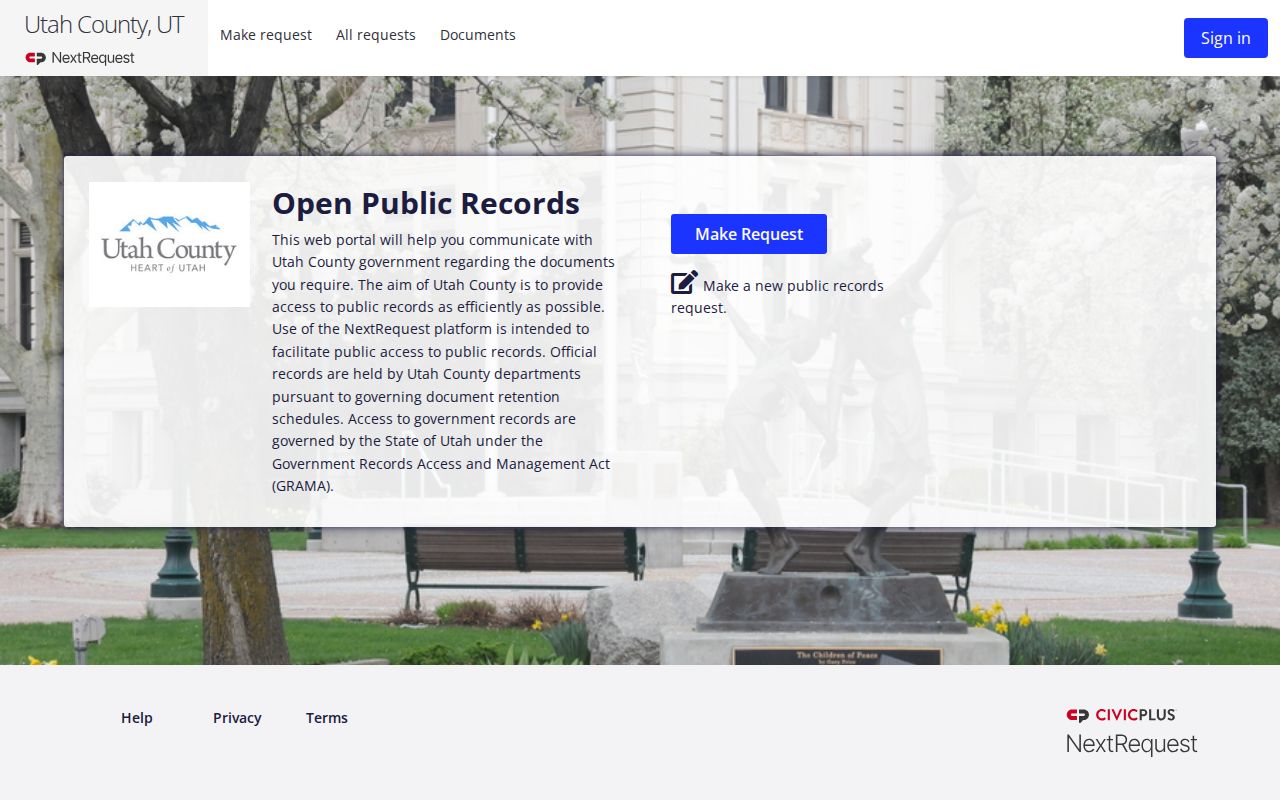
The form also requires photo identification in JPG, PNG, or PDF format no larger than 1MB, and it can email a PDF receipt.
Lawful personal use. Open records support family history, heir research, civic review, and fraud checks. Utah law forbids stalking and harassment, including harmful monitoring or misuse of personal information.